
Why Does Water Show Up in a Western Washington Crawl Space Only After Atmospheric-River Storms, and Is It a Defect or Normal?
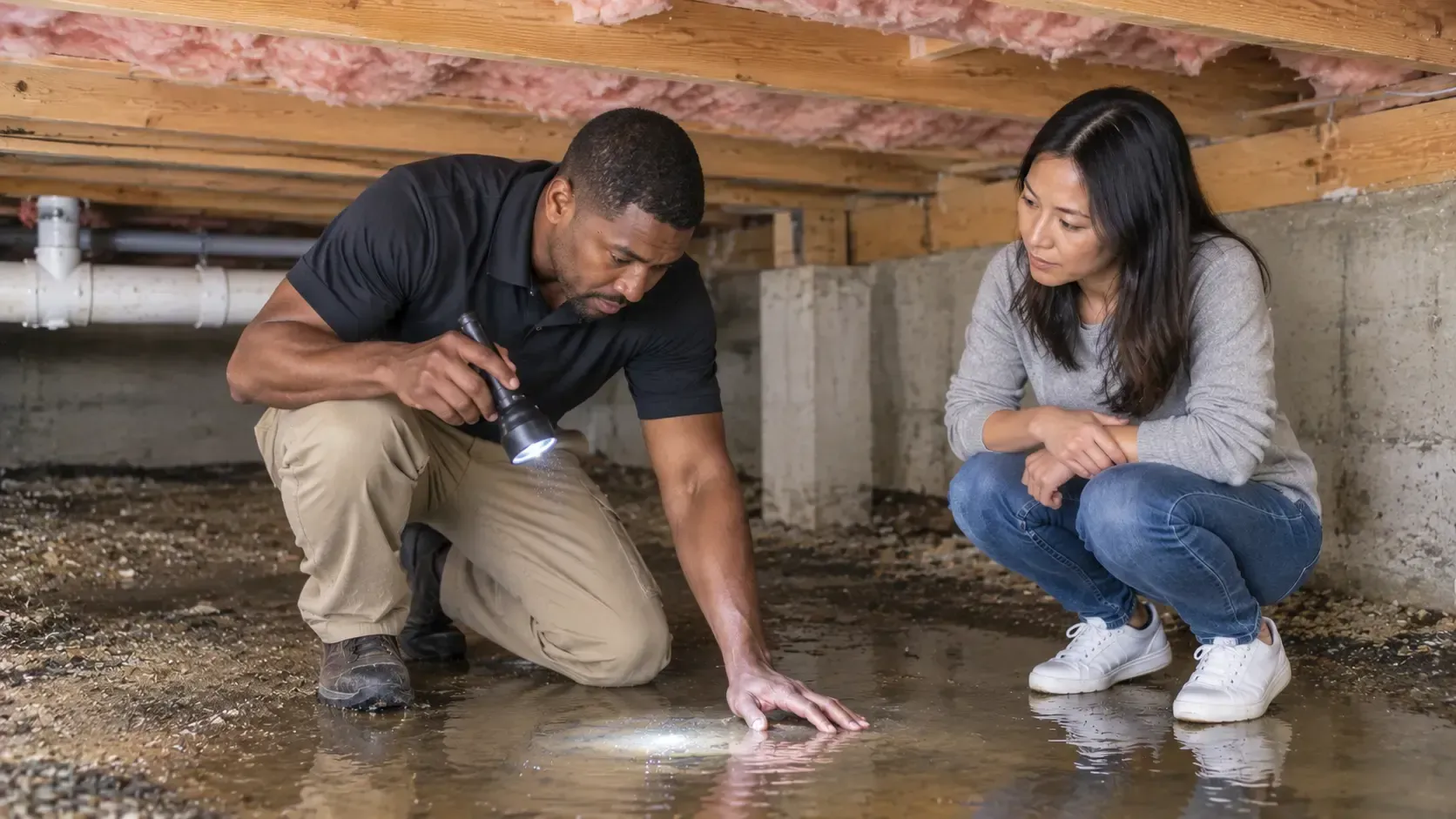
Table of Contents
- Introduction
- Where Crawl Space Water Actually Comes From
- Why an Atmospheric River Moves So Much Water
- Damp Versus Standing Water: What Counts as Normal
- The Signs That Make Crawl Space Water a Defect
- What an Inspector Can and Cannot Tell You Down There
- What to Do Before the Next Storm
- Conclusion
- Have a Crawl Space You Have Not Looked At?
- Frequently Asked Questions
Key Takeaways
- Water that only arrives with storms is coming from outside, not from a pipe.
- Saturated ground, not rainfall totals, is what turns a storm into a flooded crawl space.
- Damp soil in February is ordinary. Water still sitting there a week later is not.
- Wet insulation never dries out on its own.
- "Crawl space not entered, standing water" is a real finding, not a dodge.
Introduction
Water that only turns up after an atmospheric river is almost always coming from outside the house, surface runoff, a risen water table or drainage that quietly stopped working, rather than from a pipe, which is exactly why a crawl space check belongs on your calendar twice a year instead of once a decade.
Whether it counts as a defect is a different question, and the answer depends less on the water being there than on what it does in the days afterward.
Where Crawl Space Water Actually Comes From
Four sources, and they are not equally likely.
Surface water, by a wide margin. Roof runoff landing next to the foundation, a downspout discharging too close to the wall, grade sloping back toward the house, a patio shedding the wrong way. This is the ordinary answer, and it is usually fixable above ground.
A risen water table. Through a wet winter the groundwater level comes up, and if the crawl space floor sits at or below it, water arrives through the soil itself. Nothing in the house is broken. That distinction changes what can be done about it.
Drainage that has stopped working. Footing drains silt up and fill with roots. A sump pump seizes, loses power, or discharges somewhere the water returns from. These fail quietly, and nobody notices until a storm tests them.
Plumbing, last and least likely. The giveaway is the calendar. A leak does not care what the weather is doing, so water in August is a pipe. Water that only shows up after a storm is coming from the ground.
That single test, does it track the weather, sorts most of these cases before anybody crawls anywhere.
Why an Atmospheric River Moves So Much Water
It is not really about how hard it rains.
An atmospheric river is a long, narrow plume of moisture that parks over the region and keeps delivering for a day or more. The thing that makes it damaging around Puget Sound is not the intensity of any one hour, it is that it arrives on ground that has already been soaking since October.
Saturated soil has no capacity left. Rain that would have soaked in during September has nowhere to go in January, so it runs along the surface instead, and the surface it runs along slopes toward somebody's foundation. The house did not change. The ground around it lost the ability to absorb anything.
This is why a crawl space that behaved for years can flood in a single season. A neighbor regrades, a big fir comes down, a downspout extension gets knocked loose, and the first long storm finds the new weak point.
Damp Versus Standing Water: What Counts as Normal
Some crawl space water in a western Washington winter is ordinary. Plenty of it is not. Here is roughly where the line sits.
Ordinary for the season:
- Soil that is cool and slightly damp to the touch
- Condensation on cold duct surfaces and on the underside of the vapor barrier
- Elevated humidity that drops again when the weather breaks
- An earthy smell that clears as things dry
Not ordinary, in any season:
- Water you can actually see standing
- Water still present days after the rain stopped
- A vapor barrier floating, displaced, or holding water on top of it
- Insulation that is wet, sagging, compressed, or has fallen out of the joists
- Rust on duct straps, hangers and metal connectors
- Soft or discolored wood at post bases and along the mudsill
- A consistent stain line on the foundation wall, which is a record of how high the water gets
The honest test is duration and repetition, not presence. Damp after a storm is weather. Wet in the middle of a dry spell is a problem.
The Signs That Make Crawl Space Water a Defect
These are the ones that go in a report rather than a footnote.
- A sump pump that does not run, runs constantly, or pumps to a spot where the water comes straight back
- Water present when it has not rained recently, which points at groundwater or a failed drain rather than a storm
- Wet insulation, which matters more than people expect: it does not dry out, it compresses, it loses its value entirely, and it stays a damp mass against the floor above
- A torn, missing or submerged vapor barrier, which is the one thing keeping ground moisture out of the house
- Rot, rust or deteriorated wood at structural contact points
- Efflorescence or repeat staining, which proves this is not a one-off
A damp crawl space in February is a maintenance conversation. Any of the above is a defect, and it belongs in writing before anybody signs anything.
What an Inspector Can and Cannot Tell You Down There
Being straightforward about the limits, because they are written down and you can read them yourself.
What happens on a normal inspection: the crawl space gets entered when it is safe and accessible, and what gets looked at is moisture, drainage, insulation, the vapor barrier, foundation and footing conditions, and visible rot or pest damage. Findings go in the report with photographs.
What is outside it. The inspection agreement defines the job as a visual inspection of the apparent condition of the readily accessible installed systems and components, and says latent and concealed defects are excluded. "Readily accessible" means nobody is required to move soil, equipment or stored belongings. Nobody digs, and nobody can tell you what the ground is doing from standing on top of it.
Mold is specifically excluded, along with fungi and pest infestation. So "is that mold?" is not a question this inspection answers, and anybody who tells you otherwise is going past their own agreement. Visible rot and water damage get reported. Identifying growth is a different specialist.
And sometimes nobody goes in. Standing water near wiring, an access that is too tight, a collapsed barrier across the opening: entry does not happen. A report that says "crawl space not entered, standing water observed" is not ducking the question. It is the only responsible thing to write, and it is your signal to get a drainage contractor out before your contingency expires rather than after.
What nobody should do is prescribe the fix from a blog post. Whether a crawl space needs perimeter drains, a sump, regrading, a new barrier or just a downspout extension depends on where the water is coming from, and that takes somebody standing in it.
What to Do Before the Next Storm
Most of this is free and takes an afternoon.
- Walk the perimeter while it is actually raining. Ten minutes in the rain teaches you more than an hour on a dry day, because you can see where water goes instead of guessing.
- Look at where every downspout discharges. Extensions are the cheapest item on this list and they solve a surprising share of cases.
- Clear the gutters before the season rather than during it, which is the same reasoning behind the rest of the winter prep list.
- Check the grade in the first few feet against the foundation, where it matters most and where landscaping tends to undo it.
- If there is a sump, test that it actually cycles and confirm the discharge goes somewhere the water will not return from.
- Go and look after the first big storm, with a flashlight, and then again a week later. The second visit is the informative one, because it tells you whether the space drains or just holds.
If you are buying rather than maintaining, the crawl space is one of the places where it pays to know exactly
what gets inspected before you waive anything. That is as true for
Sammamish homes on the plateau as it is for older
Seattle neighborhoods built into hillsides.
Conclusion
Go down there after the next long storm, then go back a week later. The useful question about crawl space water is never whether it showed up, it is whether it left. A space that is damp after a storm and dry a week on is doing what western Washington crawl spaces do. One that still holds water has a drainage problem, and those do not improve on their own. The house will tell you which one you have, as long as you look at the right time of year.
Have a Crawl Space You Have Not Looked At?
A buyer's inspection should always include it, and the report should say what was found and what could not be reached. From The Ground Up Home Inspections is run by Kirk Oren, who spent more than 25 years in construction and general contracting before founding the company in 2010, and who is RESNET, Infrared and BPI certified and has been a certified energy auditor since 2012. We cover Sammamish, Seattle, Bellevue and more than 20 surrounding communities, seven days a week from 8am to 5pm. Book a
pre-purchase inspection by calling (253) 377-7400, or
book a time online.
Frequently Asked Questions
Is water in a crawl space normal in western Washington?
Some seasonal dampness is. Cool, slightly damp soil and condensation during a wet winter are ordinary. Standing water, or water still present days after the rain stops, is not normal in any season and should be reported.
Where does crawl space water come from after heavy rain?
Usually surface runoff from roofs, downspouts or grading that directs water toward the foundation, or a water table that has risen through a wet winter. Failed footing drains and sump pumps are next. Plumbing leaks are the least likely.
How can I tell if it is a leak or groundwater?
Watch the timing. A plumbing leak ignores the weather and shows up in dry months too. Water that only appears during and after storms, and only in winter, is coming from the ground outside the house.
Does a home inspector go into a flooded crawl space?
Only if it is safe and accessible. Standing water near wiring, a collapsed barrier or a very tight opening can all stop entry. The report should then record that it was not entered and why, which is a finding in itself.
Does a home inspection cover mold in a crawl space?
No. Molds and fungi are specifically excluded by the inspection agreement. Visible rot, water damage and wet insulation are reported, but identifying growth requires a different specialist.
Does a Home Inspection Say Anything About Slope Stability on a Hillside Lot in Issaquah or Kirkland?