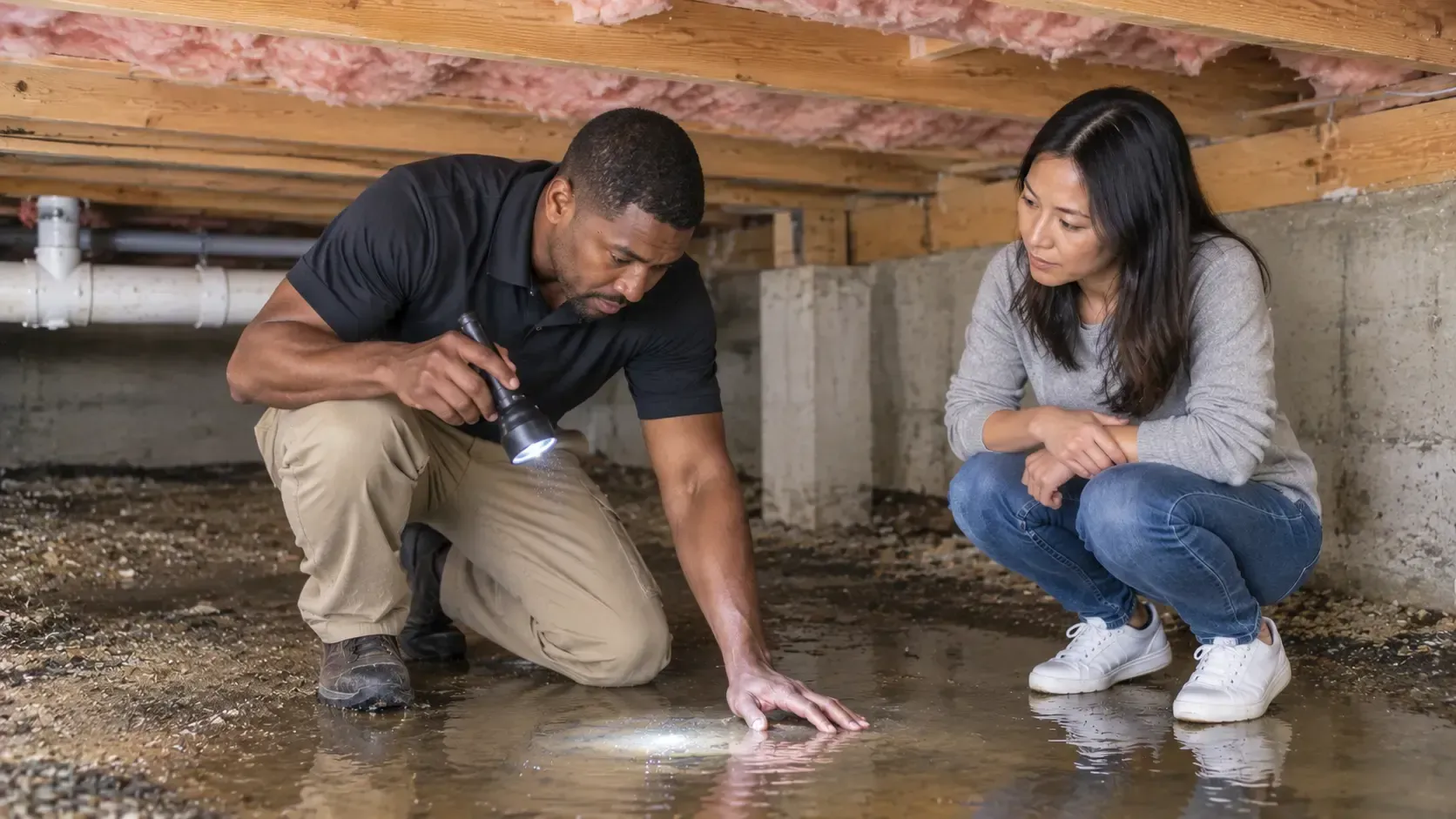
Does a Home Inspection Say Anything About Slope Stability on a Hillside Lot in Issaquah or Kirkland?
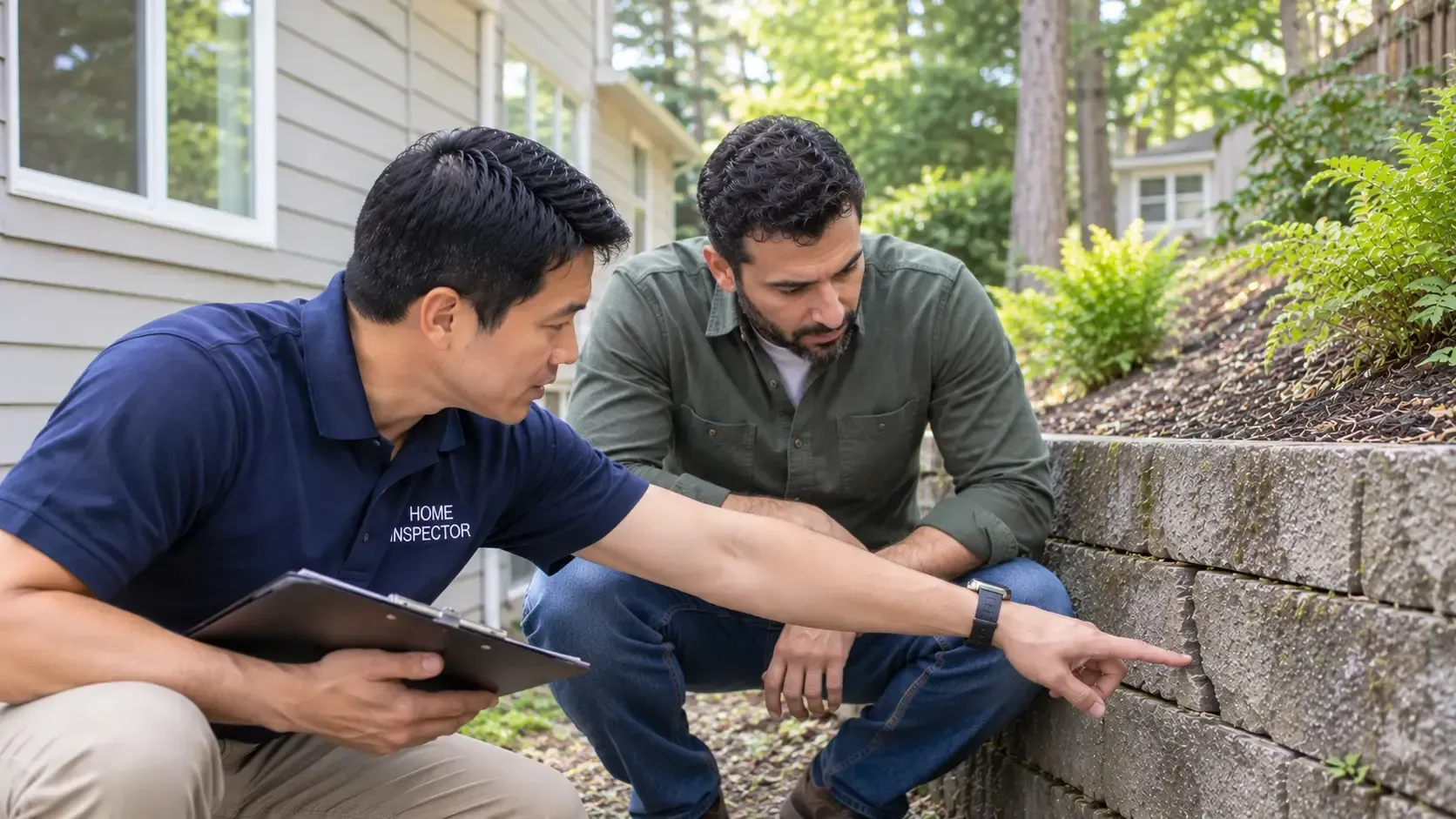
Table of Contents
- Introduction
- What the Inspection Is, in the Words of the Agreement You Sign
- What Your Inspector Can Actually Flag on a Slope
- What Takes a Geotechnical Engineer Instead
- Why a Home Inspection and an Engineer Are Not Competing
- What Winter Does to Hillside Lots
- Questions to Ask Before You Buy on a Slope
- Conclusion
- Schedule the Inspection and Ask What It Covers on Your Slope
- Frequently Asked Questions
Key Takeaways
- The word "soil" appears in the inspection agreement as something nobody has to move.
- Leaning walls, out-of-plumb fences and tilting patios are reportable signs, not verdicts.
- Slope stability needs subsurface work: borings, test pits, an engineer's stamp.
- The two services answer different questions and run in sequence, not competition.
- A hillside lot viewed in August shows you less than the same lot in February.
Introduction
Not in the way most buyers hope, because a home inspection is a visual review of readily accessible parts of the house, so it can flag a cracked retaining wall or a fence gone out of plumb, while soil behavior and slope stability belong to a geotechnical engineer and have to be asked for separately.
That is not a dodge. It is a real line, it is written into the paperwork, and knowing where it sits is what keeps a hillside purchase from going badly.
What the Inspection Is, in the Words of the Agreement You Sign
A home inspection is defined in writing, and the definition is public. You do not have to take anybody's word for it. The agreement sits on the site and you can read it before you book.
It defines the work as a visual inspection of the apparent condition of the readily accessible installed systems and components. It states that latent and concealed defects and deficiencies are excluded. And it defines "readily accessible" to mean components the inspector can reach without being required to remove personal items, furniture, equipment, soil or snow.
Read that last clause again, because it answers the question on its own. Soil appears in the agreement exactly once, in the list of things nobody is obliged to move. An inspection happens on the surface, in a few hours, with eyes and hands and a camera. Whatever the ground is doing underneath is not in scope and never has been.
The agreement also says the report adheres to the Washington State Standards, available on request, and that the inspector is not an insurer or guarantor against defects. Those are worth reading too.
What Your Inspector Can Actually Flag on a Slope
Quite a lot, as it turns out, and it is all symptom rather than diagnosis.
The exterior portion covers grading and drainage, and retaining walls that may have an effect on the structure, which is spelled out in our full walkthrough of the process. On a sloped lot, these are the things worth looking hard at:
- Retaining walls that are cracked, bulging, leaning outward, or rotated at the top
- Fences, posts and utility poles out of plumb, especially where several lean the same direction
- Patios, walkways and driveways that have tilted, separated at joints, or developed a step
- A deck or stair pulling away from the house at its attachment
- Stair-step cracking in foundation walls or masonry
- Doors and windows out of square inside the house, where movement eventually shows up
- Drainage discharging over the crest of a slope instead of away from it
One more to notice yourself: trees with a curved sweep at the base of the trunk can indicate soil that has crept downhill over years. Trees and plants are specifically excluded from the inspection, so that is an observation for you rather than a line in the report, but it is worth having in your eye as you walk the lot.
What none of these establish is whether the slope is stable. They establish that something has moved, or that water is going somewhere it should not. That is the point at which somebody else gets called.
What Takes a Geotechnical Engineer Instead
Everything below the surface, which is the part that actually determines the answer.
A geotechnical engineer looks at soil type and layering, depth to groundwater, how the slope behaves when saturated, and whether a wall or foundation was designed for the loads it carries. That means subsurface work: test pits, borings, lab analysis, calculations. None of it is visual, and no amount of experience lets anybody skip it by looking at the yard.
Two other things belong on an engineer's desk rather than an inspector's:
- Whether an existing retaining wall was engineered and permitted. Many jurisdictions require both above a certain wall height, and that height is set locally rather than nationally, so the local building department is who to ask.
- Whether the parcel sits in a mapped geologic hazard or critical area. Counties and cities in Washington maintain that mapping and the rules that come with it, which can affect what you are allowed to build later. Ask the local permit counter about the specific parcel.
This article does not state landslide or slope risk for any neighborhood, street or parcel, and neither should any inspector. That is not modesty, it is accuracy: risk at that level is parcel-specific and it is the engineer's and the jurisdiction's call.
Why a Home Inspection and an Engineer Are Not Competing
They answer different questions, and the order matters.
A home inspection answers "what condition is this house in, and what is going to cost me money." The engineer answers "is the ground under it going to stay where it is." Buying a hillside house and getting only the second would be strange. Getting only the first and assuming it covered the slope is the mistake that actually happens.
In practice the inspection is what tells you whether the engineer question is live. An inspector who finds a leaning wall, a stair-step crack and downspouts dumping over the crest has handed you three reasons to spend money on an engineer, plus the documentation to justify extending your contingency while you do it.
So: inspection first, because it is faster and cheaper and it tells you what to ask next. Then the specialist, if the lot or the findings give you a reason.
The reverse holds too. If an inspector tells you a slope is fine, treat that like a plumber telling you the roof is fine. It may be a reasonable guess. It is not a professional opinion.
What Winter Does to Hillside Lots
Slopes move on a seasonal schedule, which creates an awkward problem for buyers.
Saturated soil is heavier and weaker than dry soil, so movement happens during and after the wet months. The evidence, a new crack, a wall shifted further, a fence leaning more, mostly appears between late autumn and spring.
Which leads somewhere uncomfortable: a hillside house viewed in August tells you less than the same house in February. The dry-season version of a property is the flattering one. Nothing is being hidden, the ground simply is not under load. Buying on a slope in summer gives you fewer symptoms, not fewer problems.
A few things make a slope's winter harder, and they show year-round:
- Roof water and driveway runoff directed over the top of a slope
- Downspouts with no extensions on the uphill side of the house
- Irrigation running on or above a slope
- Vegetation stripped off a bank, since roots were holding it
- Fill that was placed rather than native ground, which behaves differently
Sloped lots are ordinary around here. Plenty ofIssaquah homes sit on grade changes, and the same is true of a good share ofKirkland hillsides running down toward the lake. Ordinary does not mean uniform, which is why the questions below are per-property.
Questions to Ask Before You Buy on a Slope
Ask these early, while you still have room to act on the answers.
- Ask your inspector in advance what they will and will not cover on this particular lot, and get the answer before the appointment rather than in the report.
- Ask the seller for any geotechnical report, drainage design or engineering for existing walls. Houses built on slopes often had one at the original permit stage, and it may still exist.
- Ask whether retaining walls on the property were permitted, which the local building department can usually tell you.
- Ask the city or county whether the parcel is in a mapped geologic hazard or critical area, and what that means for anything you might want to build.
- Ask where the drainage discharges and whether the system has ever been maintained.
- Keep the inspection contingency long enough to get an engineer out if something turns up. This is the one people get wrong, because the engineer cannot be booked for tomorrow.
The same logic applies to work you have done later. The reason it pays to catch problems while they are still visible is the whole argument behind aframing inspection before the drywall goes on, and a slope is the same idea at a larger scale.
Conclusion
The practical move on a hillside lot is to treat the home inspection as the thing that tells you whether you need an engineer, not as the thing that answers the slope question. Book it, read the exterior section carefully, and if there are leaning walls, stair-step cracks or water going over the crest, spend the money on a geotechnical opinion before your contingency runs out. The soil under a house is the one part of the purchase nobody can assess by looking at it, and it is also the most expensive part to be wrong about.
Schedule the Inspection and Ask What It Covers on Your Slope
Call before you book and describe the lot. We will tell you straight what the exterior review will and will not cover, and what the report can give you to take to an engineer if it comes to that. From The Ground Up Home Inspections is run by Kirk Oren, who spent more than 25 years in construction and general contracting before founding the company in 2010, and who is RESNET, Infrared and BPI certified. We cover Sammamish, Seattle, Bellevue and more than 20 surrounding Washington communities, seven days a week from 8am to 5pm. Book abuyer's inspection on (253) 377-7400, orcall or write through the site.
Frequently Asked Questions
Does a home inspection check slope stability?
No. The inspection is a visual review of readily accessible parts of the house. It can report visible signs of ground movement such as leaning retaining walls or cracked foundations, but assessing whether a slope is stable requires a geotechnical engineer.
What is the difference between a home inspector and a geotechnical engineer?
An inspector reports the visible condition of the house in a few hours. A geotechnical engineer investigates what is under the ground using test pits, borings and lab analysis, then issues an engineering opinion on the soil and the slope.
What signs of slope movement can an inspector report?
Cracked, bulging or leaning retaining walls, fences and posts out of plumb, tilted or separated patios and walkways, stair-step cracks in foundations, doors and windows out of square, and drainage discharging over a slope.
When should I hire a geotechnical engineer before buying?
When the lot is steep, when the inspection turns up signs of movement, when retaining walls are tall or undocumented, or when the parcel may be in a mapped hazard area. Book early, because engineers are rarely available at short notice.
Is a house on a slope a bad buy?
Not inherently, and sloped lots are common across the Eastside. The risk is buying one without knowing what was never assessed. Find out what the inspection covers, then decide whether you want an engineer's opinion as well.